Northern Question : A Political History of the North-south Divide (9781786634085) by Hazeldine Tom
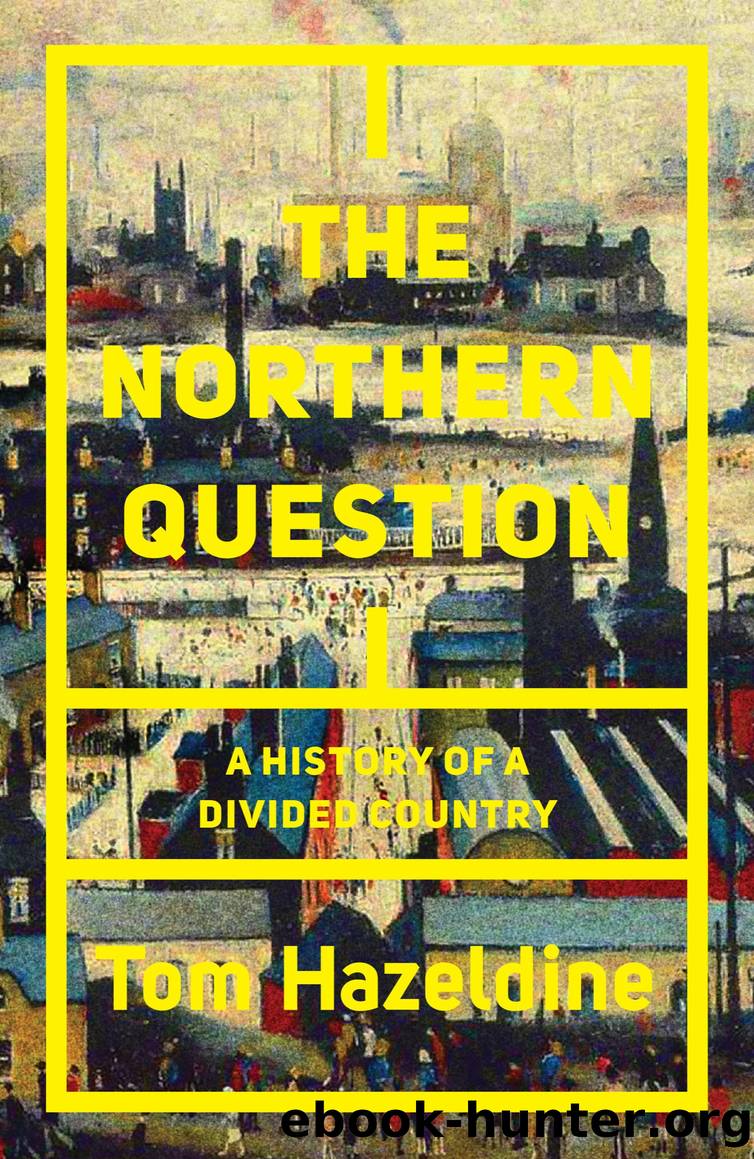
Author:Hazeldine, Tom
Language: eng
Format: epub
Publisher: Random House Digital Dist
8
Enemy Damage
A new regional journal, Southern History, appeared in 1979 just as the long economic downturn brought Thatcher to power in Whitehall. Editor John Lowerson, a historian of the leisure pursuits of the English middle classes, hailed from a Doncaster mining village and had studied at the University of Leeds during Northern Historyâs gestation period. However, his academic career swiftly removed him from this Yorkshire milieu. He taught in Lincoln and Northampton before finding a congenial berth at Sussex University, where he stayed until retirement. Immersion in the culture and society of the South Downs not only elicited from him a history of the county of Sussex but also nurtured a grievance that southern England had âbeen treated as a pale shadow of the other regions, despite its earlier social, economic and political predominance and its return to that state after the comparatively short-lived shift in gravity produced by the Industrial Revolution.â1 A hint of the triumphalism that would characterise the Thatcher years may here be discernible.
Under Thatcherâs rule, the Conservatives tightened the austerity introduced by Callaghanâs Labour, carried through the industrial shake-out Heath had attempted a decade earlier, broke the back of a labour movement responsible for bringing down the last two administrations, and completed the transformation of the City of London from a British into a freewheeling international oligarchy. With an electoral coalition firmly based in Englandâs lower half â three-quarters of Tory seats won in the South and the Midlands, as the âwealth generated by Londonâs booming financial-services industry turned neighbouring regions a deeper shade of blueâ â the New Right would see off inner city riots, steel and coal strikes, and protests against cuts in northern and inner London municipalities.2 Scargillâs Yorkshire miners, seeking to fight the idea that âany industry inside capitalist society â whether public or private sectors â has the right to destroy the livelihood of men and women at the stroke of an accountantâs pen,â went down to complete defeat, demonstrating that Whitehall at least had the power to do so.3 The legitimacy of bottom-line capitalism would not be challenged in like fashion again.
When Tory Chancellor Geoffrey Howe, a monetarist wolf in sheepâs clothing, began to turn the screws in his June 1979 budget, he was able to point to âcommon groundâ with his Labour predecessor over the need to cut public spending in order to rein in price inflation.4 Healey had bowed to pressure from the Bank of England during the IMF crisis to publish official estimates for annual growth in the money supply. Interpreted as hard targets by the financial markets, the forecasts were likened by a senior Bank of England official to a ârope round the chancellorâs neckâ.5 The Labour heavyweight had also helped to clear the ground for the Conservative assault on organised labour, berating workers who abused their industrial power to âscoop the poolâ in pay negotiations.6 He could have few complaints when Howe proceeded to squeeze corporate profits in order to stiffen managerial resolve when faced with inflationary wage demands from the shop floor.
Download
This site does not store any files on its server. We only index and link to content provided by other sites. Please contact the content providers to delete copyright contents if any and email us, we'll remove relevant links or contents immediately.
| Africa | Americas |
| Arctic & Antarctica | Asia |
| Australia & Oceania | Europe |
| Middle East | Russia |
| United States | World |
| Ancient Civilizations | Military |
| Historical Study & Educational Resources |
The Dawn of Everything by David Graeber & David Wengrow(1707)
The Bomber Mafia by Malcolm Gladwell(1625)
Facing the Mountain by Daniel James Brown(1553)
Submerged Prehistory by Benjamin Jonathan; & Clive Bonsall & Catriona Pickard & Anders Fischer(1455)
Wandering in Strange Lands by Morgan Jerkins(1430)
Tip Top by Bill James(1416)
Driving While Brown: Sheriff Joe Arpaio Versus the Latino Resistance by Terry Greene Sterling & Jude Joffe-Block(1376)
Red Roulette : An Insider's Story of Wealth, Power, Corruption, and Vengeance in Today's China (9781982156176) by Shum Desmond(1359)
Evil Geniuses: The Unmaking of America: A Recent History by Kurt Andersen(1354)
The Way of Fire and Ice: The Living Tradition of Norse Paganism by Ryan Smith(1336)
American Kompromat by Craig Unger(1315)
F*cking History by The Captain(1304)
It Was All a Lie by Stuart Stevens;(1300)
American Dreams by Unknown(1286)
Treasure Islands: Tax Havens and the Men who Stole the World by Nicholas Shaxson(1274)
Evil Geniuses by Kurt Andersen(1257)
White House Inc. by Dan Alexander(1212)
The First Conspiracy by Brad Meltzer & Josh Mensch(1174)
The Fifteen Biggest Lies about the Economy: And Everything Else the Right Doesn't Want You to Know about Taxes, Jobs, and Corporate America by Joshua Holland(1126)
